
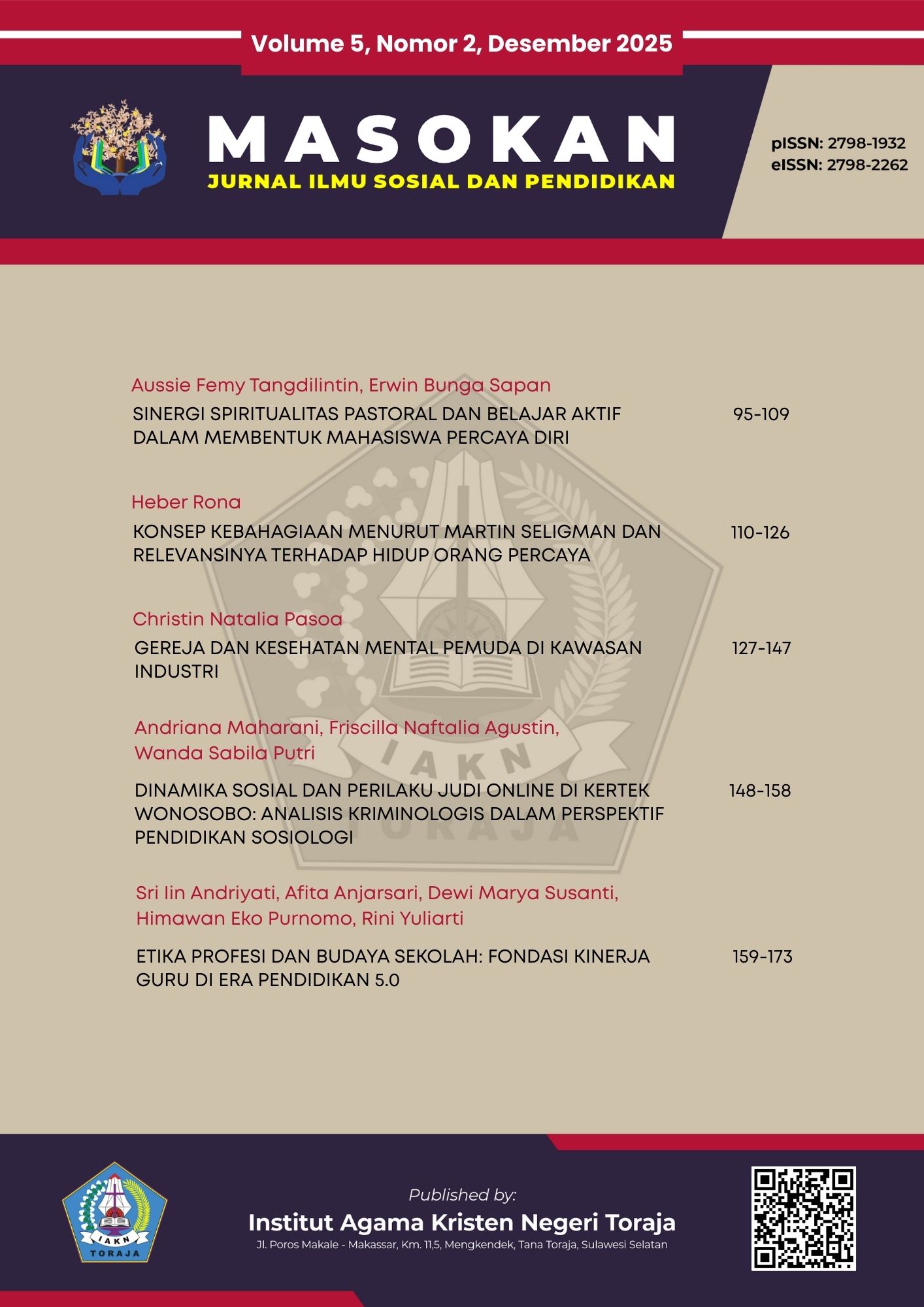
ETIKA PROFESI DAN BUDAYA SEKOLAH FONDASI KINERJA GURU DI ERA PENDIDIKAN 5.0
Article Sidebar
Main Article Content
Abstract
The transformation of the educational paradigm toward Education 5.0 requires a shift in the role of teachers from mere instructors to ethical, adaptive learning facilitators oriented toward humanistic values. This study aims to identify and synthesize the interrelationships among professional ethics, school culture, and teacher performance within the context of technology-based and human-centered educational transformation. This study employed an integrative literature review, analyzing 20 scientific articles published between 2019 and 2024 and indexed in SINTA and reputable international journals. The synthesis indicates that professional ethics provide a fundamental value framework that guides teachers’ integrity, accountability, and professionalism, while school culture functions as an ecosystem that supports the internalization of these values through a collaborative, disciplined, and quality-oriented environment. The integration of both dimensions creates synergy that strengthens teacher performance, particularly in professional responsibility, pedagogical innovation, and commitment to the quality of learning in the digital era. This study confirms that strengthening professional ethics and school culture is not only relevant as a normative discourse but also strategic as a foundation for fostering superior and sustainable teacher performance in the era of Education 5.0.
Perubahan paradigma pendidikan menuju era Pendidikan 5.0 menuntut pergeseran peran guru dari sekadar pengajar menjadi fasilitator pembelajaran yang beretika, adaptif, dan berorientasi pada nilai-nilai kemanusiaan. Kajian ini bertujuan untuk mengidentifikasi serta mensintesis keterkaitan antara etika profesi, budaya sekolah, dan kinerja guru dalam konteks transformasi pendidikan berbasis teknologi dan humanisasi. Metode yang digunakan adalah integrative literature review dengan menganalisis 20 artikel ilmiah yang diterbitkan pada periode 2019–2024 dan terindeks SINTA maupun jurnal internasional bereputasi. Hasil sintesis menunjukkan bahwa etika profesi berperan sebagai landasan nilai yang menuntun integritas, akuntabilitas, dan profesionalitas guru, sementara budaya sekolah berfungsi sebagai ekosistem yang mendukung internalisasi nilai-nilai tersebut melalui iklim kolaboratif, disiplin, dan berorientasi mutu. Integrasi keduanya menghasilkan sinergi yang memperkuat kinerja guru, terutama dalam aspek tanggung jawab, inovasi pedagogis, dan komitmen terhadap mutu pembelajaran di era digital. Kajian ini menegaskan bahwa penguatan etika profesi dan budaya sekolah tidak hanya relevan sebagai wacana normatif, tetapi juga strategis sebagai fondasi kinerja guru yang unggul dan berkelanjutan di era Pendidikan 5.0.
Article Details

This work is licensed under a Creative Commons Attribution-ShareAlike 4.0 International License.
References
Booth, A., A. Sutton, and D. Papaioannou. Systematic Approaches to a Successful Literature Review. London: Sage Publications, 2016.
Dauhan, Novientry Sangiang. “Pengaruh Budaya Kerja terhadap Kinerja Guru.” Workshop Nasional Penguatan Kompetensi Guru Sekolah Dasar 3, no. 3 (2020): 2301–6.
Eliza, Delfi, et al. “Mengenal Etika dan Etiket Guru Profesional Pendidikan Anak Usia Dini di Indonesia dan Luar Negeri.” EDUKATIF: Jurnal Ilmu Pendidikan 4, no. 3 (May 2022): 4266–78. https://doi.org/10.31004/edukatif.v4i3.2773.
Fitriyono, Irfan. “Pengaruh Budaya Sekolah Terhadap Kinerja Guru SMP Negeri Se-Kecamatan Gondokusuman.” Universitas Negeri Yogyakarta, 2018.
Forster, Daniella, and Bruce Maxwell. “Using Codes of Professional Ethics and Conduct in Teacher Education: Pitfalls and Best Practice.” In Ethics and Integrity in Teacher Education, edited by Sarah Elaine Eaton and Zeenath Reza Khan, 25–42. Cham: Springer International Publishing, 2022. https://doi.org/10.1007/978-3-031-16922-9_3.
Halder, Ishita. The Role of Professional Ethics in Teacher Education in The Light of NEP 2020. 9, no. 1 (2024).
Hosaini, et al. “Leadership Collaboration and Professional Ethics between Teachers.” n.d.
Janiah, Siti, Ahmad Suriansyah, and Rustam Effendi. “The Correlation of School Principal Communication, Work Ethic, and Work Motivation to Teacher Performance.” International Journal of Social Science and Human Research 6, no. 1 (January 2023). https://doi.org/10.47191/ijsshr/v6-i1-46.
Kitchenham, B. “Procedures for Performing Systematic Reviews.” Paper presented at Keele University Technical Report TR/SE-0401, Keele, UK, 2004.
Krippendorff, K. Content Analysis: An Introduction to Its Methodology. Thousand Oaks, CA: Sage Publications, 2018.
Lakuana, Nurhaida, and Ainil Fitri Laeh. “Etika Profesi Guru dalam Pandangan Mahasiswa Calon Pendidik.” Damhil Education Journal 5, no. 1 (June 2025): 44. https://doi.org/10.37905/dej.v4i2.2820.
Mahulae, A’en Vater, Prihatin Lumbanraja, and Elisabet Siahaan. Effect of Professionalism and Competence of Teachers on Teacher Performance and Its Impact on Student Learning Outcomes at Harapan Mandiri College. no. 11 (2020). 39-46.
Masitoh, Sabingatun Dewi, and Dwi Purbowati. Enhancing Teacher Professionalism in Indonesia: Challenges and Strategies for Digital Technology Utilization in the Society 5.0 Era. 4, no. 2 (2024).
Nihaya, Musdalifah. “Peran Etika dan Profesi Keguruan dalam Membangun Karakter sebagai Calon Guru.” Jurnal Magister Pendidikan Islam 4, no. 2 (2024): 2580–5304.
Rivero, Josua Arizo. School Culture, Job Performance of Teachers, and Academic Achievement of Students. 12, no. 5 (2025).
Roring, Timmy Ardian, and Marselius Sampe Tondok. “Implementasi Etika Jawa dalam Praktik Kepemimpinan Sekolah.” Jurnal Pendidikan dan Kebudayaan 10, no. 1 (June 2025): 89–115. https://doi.org/10.24832/jpnk.v10i1.5873.
Şahin, Fatih, and İbrahim Yüksel. “Meaning and Uniqueness of Ethics and Ethical Teacher Behaviors in the Teaching Profession.” 13, no. 2 (2021): 1–16.
Snyder, H. “Literature Review as a Research Methodology: An Overview and Guidelines.” Journal of Business Research 104 (2019): 333–39. https://doi.org/10.1016/j.jbusres.2019.07.039.
Sukmawati, Anis, Ghina Zayyina Amalia Mozamb, and Inggit Delia Zulfa. “Perkembangan Pendidikan dan Pembelajaran Era Society 5.0.” Hijri 12, no. 1 (June 2023): 92. https://doi.org/10.30821/hijri.v12i1.16858.
Sunarwan, Wawan, and Imron Rosadi. Membangun Budaya Sekolah yang Positif: Faktor-Faktor Penentu dan Hasilnya terhadap Kinerja Guru dengan Tinjauan Sistematis Literature Review. n.d.
Tanan, Dalpin, and Rijanto Purbojo. “Pengaruh Persepsi Guru Tentang Budaya Sekolah dan Gaya Kepemimpinan Digital terhadap Perilaku Kerja Inovatif Guru di Sekolah XYZ Manado.” Jurnal Manajemen Pendidikan 12, no. 1 (2025).
Torraco, R. J. “Writing Integrative Literature Reviews: Guidelines and Examples.” Human Resource Development Review 15, no. 4 (2016): 404–28. https://doi.org/10.1177/1534484316671606.
Zajuli, Sulaiman Ahmad, and Astuti Darmiyanti. “Etika dan Profesionalisme dalam Pembentukan Guru yang Berkarakter.” Jurnal Ilmiah Wahana Pendidikan 9, no. 2 (2023): 591–99. https://doi.org/10.5281/zenodo.7584698.